
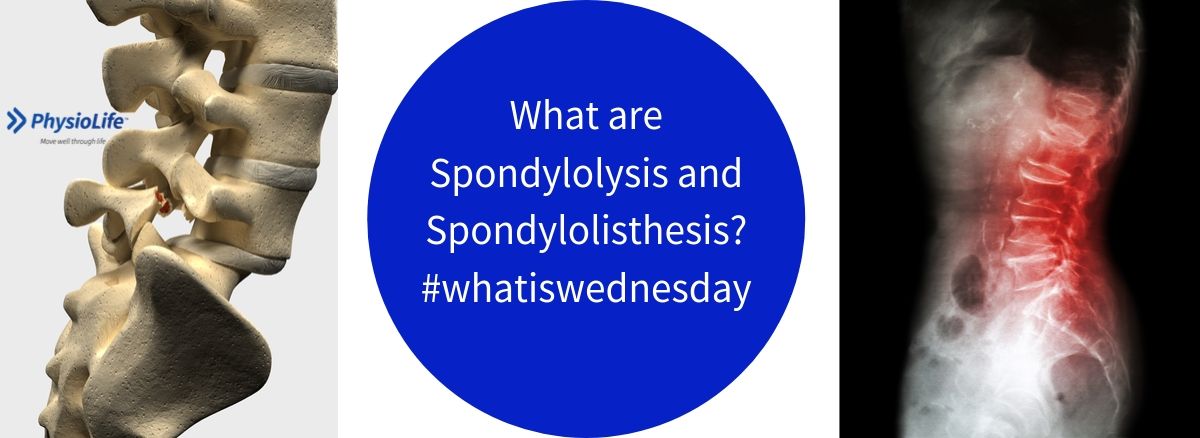
What Are Spondylolysis andSpondylolisthesis?
By Laurence Schubert APAM
The spine is arguably the most importantstructure in the human body. As humans, we are endoskeletons, meaning our bonesare found on the inside of our body. Often referred to as the spinal column,the spine is strong supporting structure that provides the entire framework forour body. Whilst the spine is robust, it has an important function of allowingmovement. Like the entire human body, the spine is susceptible to injury. Youmay have heard of the terms Spondylolysis and Spondylolisthesis.
What Are Spondylolysis andSpondylolisthesis?
Spondylolysis refers to a fracture in part of the vertebra that extends posteriorlyand forms the bone that you can see when people bend forward. In morescientific terms, a fracture to the pars interarticularis. When this fracture becomescomplete, and entirely separates it is known as Spondylolisthesis.
Spondylolisthesis is the complete fracture of part of the spine, occurring in progressionof a Spondylolysis. Once the fracture is separated it is given grades toclassify its severity. Generally, these two conditions affect the lower lumbar (lowback) vertebrae, typically at L4 and L5.
What are the causes?
Spondylolysis and spondylolisthesis occureither due to an acute injury or a degenerative process over time. This injurycommonly occurs in young people as a result of trauma typically when the spineis forced into extension at high loads. Sports that have repetitive extensionmovements such as gymnastics, football and weightlifting are also at risk ofthis injury, as over time it can lead to stress fracture.
In older adults, spondylolysis orspondylolisthesis will likely be caused by generative changes. Due to naturalageing processes, osteoporosis, infection or tumour can cause this injury.Genetics also play in role in these conditions as some people are more susceptiblethan others.
What are the symptoms?
Often the symptoms of Spondylolysis andspondylolisthesis are very subtle, and it is likely that you will not evennotice them. As the symptoms progress, you will begin to experience pain andtightness across the low back. This condition is easy misdiagnosed as muscularstrain as pain often presents similarly across the low back. It is likely thatbending forward will help relieve your symptoms and aggravated by walking,running (especially uphills) or anything that causes spinal extension.
If the conditions become more progressive, therecan be a slipping forward/backward of the vertebral body (bone in between yourdiscs). This causes a narrowing of the spinal canal and compresses the spinalcord, thus causing neural symptoms. This includes pain and tightness down yourhamstring/thigh, numbness and tingling, weakness and unco-ordinated lower limbmovements.
How can your physiotherapist help?
Your physiotherapist will first ensure acorrect diagnosis. Spinal issues are made complex if poor diagnosis takesplace. Then your physio will work with you in determining whether any otherhealth professionals are needed for the management of your case. In severecases, stabilisation surgery may be required. However, this in rare and in mostcases Spondylolysis and spondylolisthesis can be managed conservatively (nosurgery).
Physiotherapy will likely focus on altering/modifyingyour current physical activity. It is important that we help you find ways foryou to continue doing the things you love, whether this be sports/gym or activitiesat home such as gardening. Strength training is often a significant aspect ofrehab, as well as improving mobility in the spine and other areas that require attention.
If you have any questions about back pain or these two conditions then please contact us or book online for an appointment